Power

Goblin



This documentation is an english translation and adaptation derived from the preliminary analysis done in the MitViDi guide.
Recommendation for the purchase of current measurement equipment
The purpose of the current measurement hardware recommendation is to describe the minimum hardware configuration to perform a single current measurement on a system that is as representative as possible of the potential production system. The hardware arrangement describes either server or terminal equipment. If the measurement is to be extended to cover a wider arrangement, the configuration of the recommendation serves as a flexible starting point. The recommendation excludes equivalent systems with characteristics that differ significantly (e.g. instruction set) from the typical representative system (PC/ARM).
The mapping exercise resulted in a recommendation for the following power meters:
- HardKernel SmartPower 3, for devices with consumption up to 50W
- Powerwerx PWRcheck+, for devices up to 200W consumption
- Power measurement circuit: INA219, INA260, INA169, CS5463 or CS5490 for a project requiring a high level of electronics design.
The mapping exercise resulted in the following recommended measurable chassis:
- PC hardware: an Up Board, PC Engines APU2, Intel NUC or other x86-based low-power platform that can be limited to a single voltage level (e.g. using a PicoPSU).
- ARM hardware: Raspberry Pi, Odroid or similar card-based computer
For this document, we have extracted from the above one type of measurement and two types of system under test (SUT) hardware that can be used to perform representative power measurements. These options are presented below.
SUT (2 options)
The purpose of the SUT is to represent a typical server or terminal device running software. Due to the operational limitations of the power meter, the recommended device is a single-voltage, "card computer", whose power consumption is kept within the operating range of the metering equipment. The extension of the range and number of devices to be measured beyond the recommended types is not covered by this guide.
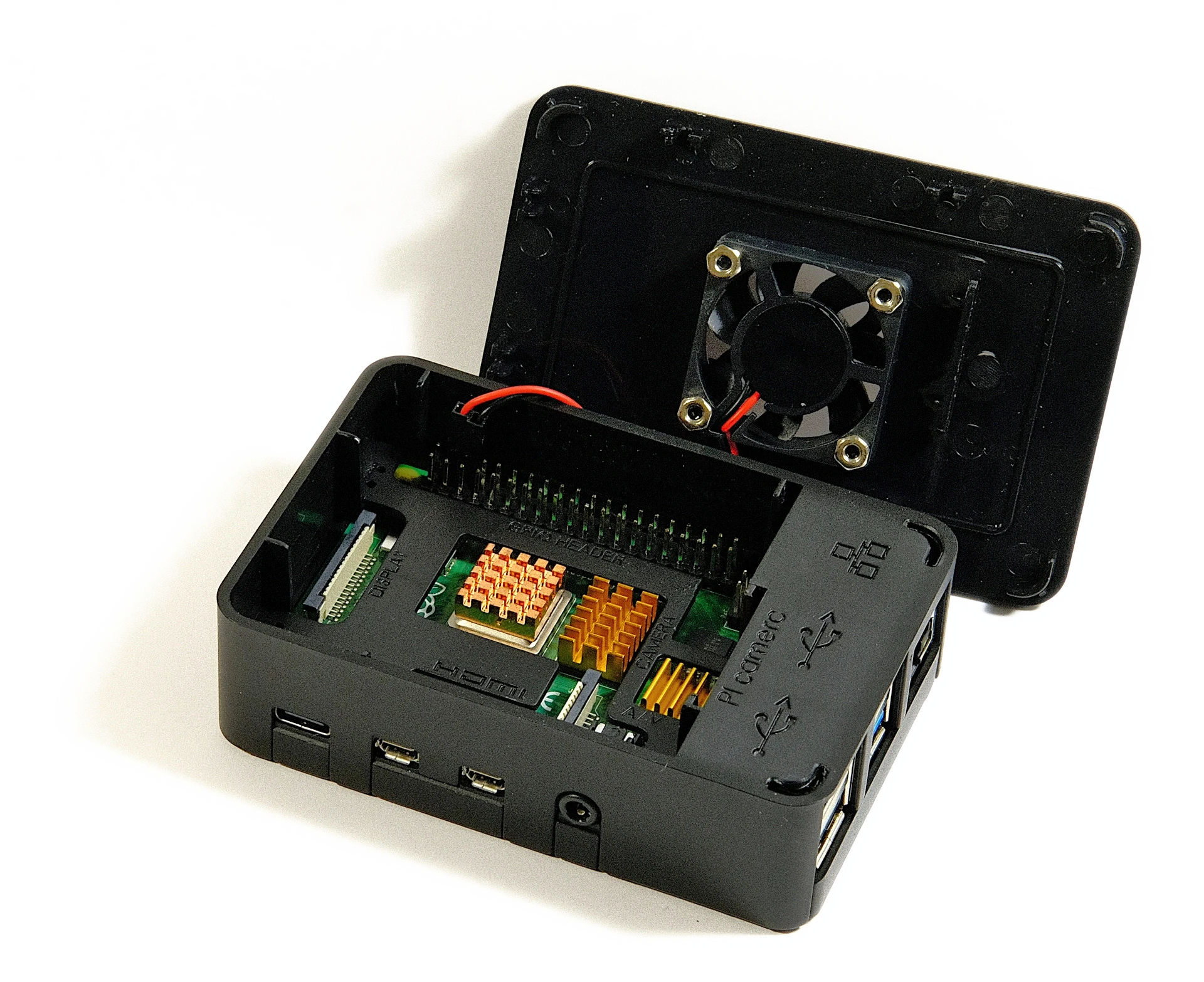
(1) Raspberry Pi 4: https://rpilocator.com/?cat=PI4
- The Raspberry Pi is the most popular card-based computer on the market. Its main selection criteria are familiarity with the platform and support for development. A wide range of software is available for the platform and it can also be used for a variety of firmware and electronics-oriented applications.
- The recommended specifications depend on the chosen application to be measured
- Recommended 4 or 8 GB RAM
- 32 GB microSD minimum recommended if Linux is used
- Note! The device is ARM-based, so the compatibility of the software to be measured must be ensured!
- Please also consider the need for a USB keyboard and mouse, Cat5e/RJ45 network cable, micro HDMI cable and other peripherals!
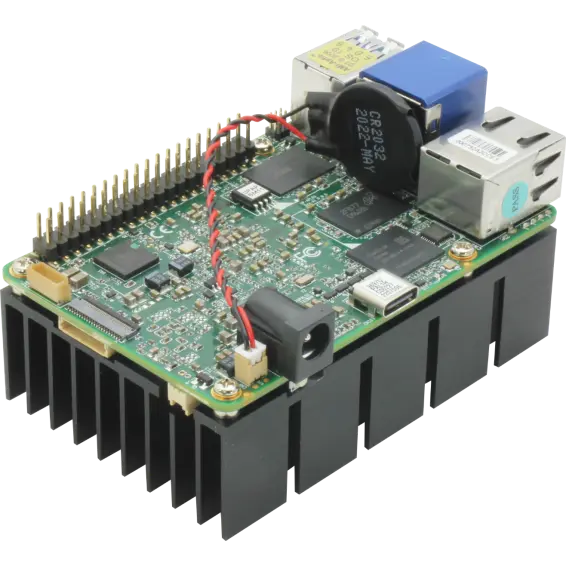
(2) UP 7000 Series: https://up-shop.org/default/up-7000-series.html
- The UP 7000 Series is an Intel x86-based card computer with very minimal differences in operating principle and compatibility from available server and workstation hardware. It is capable of running a very wide range of software and is particularly useful if the software is run on x86-based production hardware and porting the software to an ARM-based Raspberry Pi would prove cumbersome.
- The recommended specifications depend on the chosen application to be measured
- 8 GB RAM (recommended)
- 64 GB eMMC (recommended)
- 12V (recommended)
- x86 / x86-64 based: supports common PC software and operating systems
- Note! Ensure sufficient memory for the environment under test. The 8 GB of RAM provided by the device is representative of many virtual servers and lightweight workstations. Memory availability may be limited by software.
- Note! Power consumption may exceed 36W, especially when using video output and peripherals! If the power consumption of the device exceeds the capacity of the meter, choose Powerwerx PWRcheck+ or a lower power hardware option from the manufacturer!
- Also consider the need for a USB keyboard and mouse, Cat5e/RJ45 network cable, full-size HDMI cable and other peripherals!
Power measurement
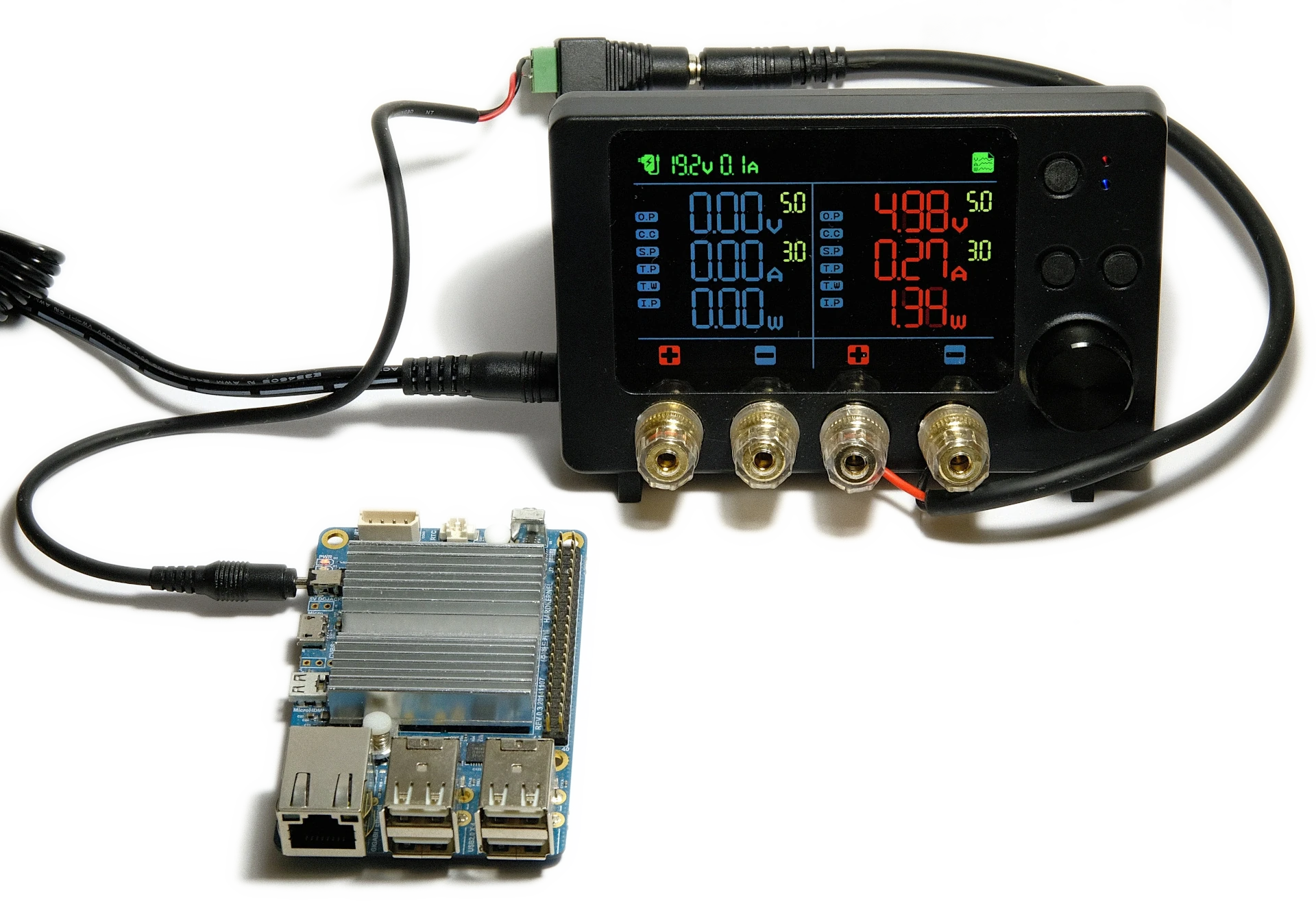
The HardKernel SmartPower 3 is the recommended power meter. The chosen power meter is relatively inexpensive and suitable for measuring the power of various small DC devices. The availability of an alternative Powerwerx PWRcheck+ meter was temporarily low during the design phase of the project, so it was not purchased for evaluation and had to be excluded from the selection of the preferred instrument. It should be noted that the HardKernel SmartPower 3 is not suitable for measuring 12V devices with a power consumption exceeding 36W.
HardKernel SmartPower 3: https://www.hardkernel.com/shop/smartpower-iii/
- Choose a PSU from https://www.hardkernel.com/shop/19v-7a-power-supply/
- The order also includes the part https://www.hardkernel.com/shop/dc-plug-cable-assembly-5-5mm/
- Both the PSU and the 5.5mm DC cable are also available for order from Finnish electronics stores
- PSU recommendation up to 21V (the meter should be able to handle 24V internally)
- PSU recommendation minimum 9V if SUT devices are operating at 5V.
- PSU recommendation of at least 13V if the SUT devices have an operating voltage of 5-12V.
- Many portable chargers are suitable as a power supply by replacing the 5.5mm DC male connector with a female connector.
The following list contains considerations for the use of the meter:
The voltage level of the power meter should be limited to the maximum level recommended by the SUT (e.g. 5V) before connecting to the measurement channel to avoid breaking the device! When making 5.5mm DC plug connections, it is recommended to measure the polarity of the DC plug with a voltmeter before connecting to avoid breaking the device! When measuring, it is not recommended to change the adjusted voltage level in order not to break the device!
Model configurations
The purpose of the model assemblies listed below is to describe the tooling and component purchases required for current measurement. The listings do not cover other possible peripheral equipment and cable requirements.
Configuration found to work with Raspberry Pi 4 Model B 8 GB (SUT #1)
- Raspberry Pi 4 Model B 8 GB
- Raspberry Pi OS
- Hardkernel SmartPower 3
- Hardkernel 19V/7A Power Supply (included)
- Hardkernel DC Plug Cable Assembly 5.5mm (included)
- 5.5mm DC female-to-female converter (connects to the previous one)
- 5.5mm DC male to USB-A intermediate cable (connects to previous)
- USB-A -> USB-C OTG cable (connects to previous)
Configuration found to work with Raspberry Pi 4 Model B 8 GB (bypasses the fuse)
- Raspberry Pi 4 Model B 8 GB
- Raspberry Pi OS
- Hardkernel SmartPower 3
- Hardkernel 19V/7A Power Supply (included)
- Hardkernel DC Plug Cable Assembly 5.5mm (included)
- 5.5mm DC female with female socket (connects to the previous one)
- Dupont male-female cable (connects to previous)
- (The Dupont female-to-female cable could also be plugged in directly instead of the previous one, but the clamping screw on the power meter may break the connector)
- Connecting to Raspberry's GND & 5V GPIO pins
- Assembly requires a Phillips or chisel-head screwdriver.
Configuration found to work with UP 7000 Series (SUT #2)
- Hardkernel SmartPower 3
- Hardkernel 19V/7A Power Supply (included)
- Hardkernel DC Plug Cable Assembly 5.5mm (included)
Multi-device measurement
- One Hardkernel SmartPower 3 supports two measurement channels and therefore two of the same or different voltage levels. Up to 50W/3A instantaneous load can be connected to one channel.
- Multiple devices can be connected to a single measurement channel with a 5.5mm DC female-to-male splitter.
- Multiple Hardkernel SmartPower 3 units can be deployed - if required, the USB port can be branched with a USB hub. Depending on the hardware and drivers, a Linux host, for example, can support up to 32-128 different units.
The project is funded by the Regional Council of Southwest Finland and the Regional Council of South Karelia through the European Regional Development Fund coordinated by the Regional Council of Uusimaa. Regional Development Fund support has been granted to the project partners through the EU-REACT call for proposals, as part of the EU recovery measures following the covid-19 pandemic.